
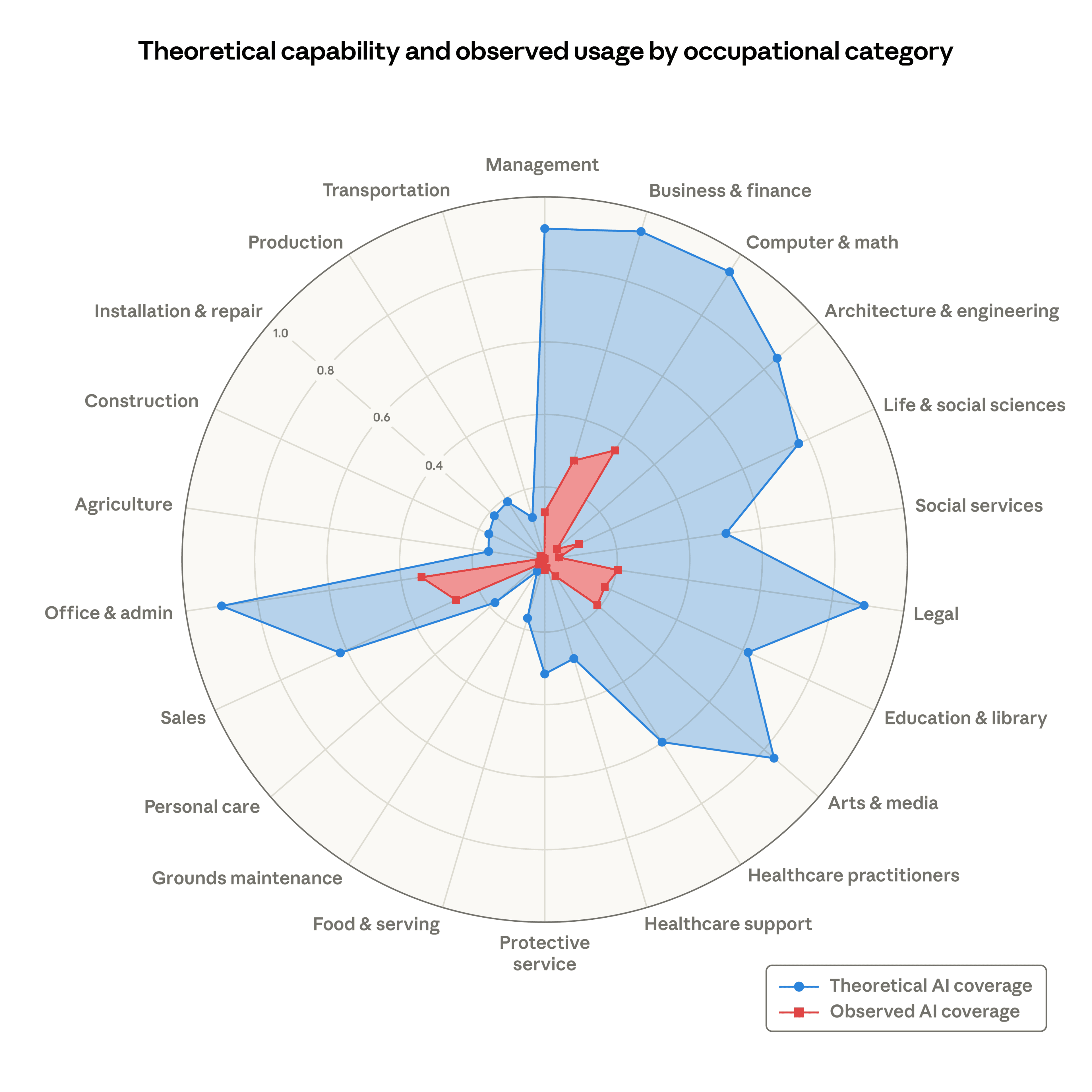
If you’ve been watching the AI-and-jobs debate this month, you’ve probably seen the chart. Anthropic released a report comparing current “observed exposure” of occupations to LLMs (in red) against “theoretical capability” (in blue) across 22 job categories. The red area is modest. The blue area is enormous.
At first glance, that blue blob suggests LLM-based systems could theoretically perform at least 80 percent of individual job tasks across everything from Arts & Media to Legal, Business & Finance, and even Management. It looks like Anthropic is predicting a tidal wave of automation that swallows most of the US workforce.
But I’ve been around long enough to know that big scary numbers usually come with big caveats. And this one is no exception.
“Theoretical capability” here isn’t a prediction. It’s a speculative estimate based on what LLMs might be able to do if future systems improve significantly and if humans adapt workflows around them. It’s not a forecast of replacement. It’s a guess about augmentation potential.
The report itself acknowledges this. The blue area represents tasks where an LLM could theoretically assist or complete the work if the right infrastructure, training, and human oversight are in place. That’s a lot of ifs. Real-world adoption has always lagged behind lab capability—we saw this with earlier automation waves too.
What’s more telling is the gap between the red and blue areas. That gap is where the actual friction lives: integration costs, regulatory barriers, human resistance, and the messy reality that most jobs involve more than isolated tasks. A lawyer doesn’t just write briefs; they manage client relationships, negotiate, and make judgment calls that no current AI handles well.
I’m not saying AI won’t disrupt jobs. It will. But this chart is designed to make you think “everything is about to be automated,” when the more honest take is “some tasks in many jobs will get easier or faster.” That’s useful, but it’s not the apocalypse.
Anthropic deserves credit for being transparent about the methodology. The problem is that a single graphic circulating without context becomes a meme. And memes are bad at nuance.
Comments (0)
Login Log in to comment.
Be the first to comment!