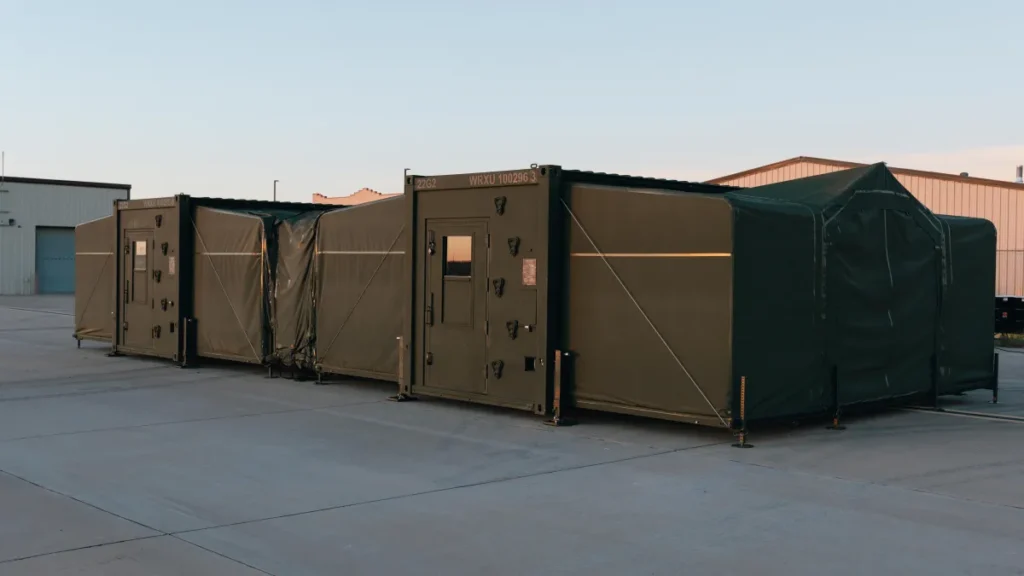

Firestorm Labs just closed an $82 million funding round, and the pitch is something straight out of a sci-fi logistics manual: put a drone factory inside a shipping container, ship it to a forward operating base, and start cranking out UAVs on site.
The company calls this concept “expeditionary manufacturing.” Instead of building drones in a centralized facility and shipping them across the globe—which takes weeks and creates a huge logistical tail—you drop a containerized production unit near the action and produce what you need, when you need it. The idea has been floating around defense circles for a while, but Firestorm is the first to get serious funding to pull it off at scale.
The $82 million Series B was led by 645 Ventures, with participation from Lockheed Martin Ventures, RTX (formerly Raytheon Technologies), and a few other defense-adjacent investors. That’s a solid signal that the military-industrial complex is paying attention.
What’s actually inside the container?
Firestorm’s system isn’t just a 3D printer in a box. The container houses additive manufacturing machines, CNC routers, assembly stations, and quality control gear. The idea is to produce drones that are simple enough to be built quickly but capable enough for reconnaissance, electronic warfare, or loitering munition roles. The company claims its Tempest drone can be assembled in under 24 hours from raw materials to flight-ready.
I’m skeptical about the 24-hour claim—that’s the kind of marketing number that tends to stretch in practice. But even if it takes two or three days, that’s still a massive improvement over the current procurement cycle, which can take months or years for specialized military drones.
Why this matters beyond the battlefield
This isn’t just a military story. The underlying tech—containerized, decentralized manufacturing—has applications in disaster response, infrastructure repair, and even commercial logistics. If you can deploy a factory to a war zone, you can deploy one to a hurricane zone or a remote mining site. The unit is designed to run on standard military power or generators, so it doesn’t need a dedicated facility.
Firestorm’s approach also sidesteps a persistent problem in defense procurement: single points of failure. A centralized factory gets bombed, and your drone supply dries up. A distributed network of container factories is harder to disrupt. That’s the kind of resilience the Pentagon has been talking about for years but rarely funds effectively.
The catch
Containerized manufacturing isn’t a silver bullet. The drones you can build inside a shipping container are necessarily limited in size and complexity. You’re not going to produce a Predator or a Reaper in there. These are small, tactical UAVs with limited payload capacity and range. That’s fine for many missions, but it won’t replace the high-end stuff.
There’s also the question of supply chains for raw materials. You still need to feed the container with filament, electronics, and other components. If those get interdicted, the factory stops. Firestorm says they’re working on sourcing local materials where possible, but that’s easier said than done in a conflict zone.
Still, $82 million is a serious vote of confidence. The company now has the runway to deploy these units in field tests and, presumably, real operations. The defense industry moves slowly, but when it moves, it tends to spend big.
I’ll be watching to see how the Air Force and Army actually use these things. If they work as advertised, we’re looking at a fundamental shift in how military hardware gets made and delivered. If they don’t, well, at least the concept will push the incumbents to innovate faster.
Comments (0)
Login Log in to comment.
Be the first to comment!