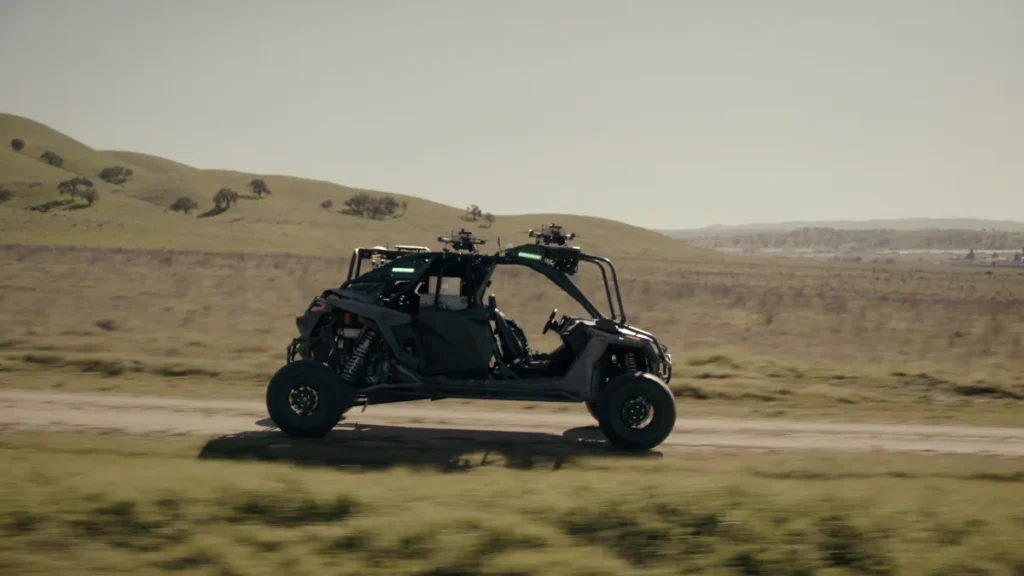

Colby Adcock just raised $100 million for Scout AI, and I got to see where that money’s going. Not a sterile office or a data center, but an honest-to-god training ground where they’re teaching AI agents to fight alongside human soldiers.
The premise is simple on paper but terrifying in practice: give one soldier the ability to control a fleet of autonomous vehicles. Drones, ground rovers, maybe even boats. The AI acts as a middleman, translating human intent into machine commands fast enough for combat.
I walked through their bootcamp last week. It’s a converted military base about an hour outside Raleigh, North Carolina. Old barracks turned into server rooms, a shooting range repurposed for drone obstacle courses. The smell of gunpowder and burnt wiring hits you before you even get past the gate.
Adcock showed me a demo. A soldier wearing a modified helmet with a neural interface — think a cheap EEG headset strapped to a ballistic helmet — stood in a field. He thought “send the quadcopter to the treeline” and three drones lifted off simultaneously. One went high for surveillance, two flanked low. The AI handled the formation, the collision avoidance, the radio handoffs.
The soldier didn’t touch a joystick. He just thought about what he wanted, and the AI made it happen.
It’s not telepathy. The system reads specific brainwave patterns associated with directional intent. Left, right, forward, stop. The AI fills in the gaps. “We’re not reading thoughts,” Adcock told me. “We’re reading commands. It’s closer to a keyboard shortcut than mind control.”
Still, it’s unsettling to watch. The drones moved with a coordination that felt almost organic. When one lost signal, the others adjusted automatically. No hesitation. No human in the loop for the granular stuff.
Scout AI’s pitch to the Pentagon is straightforward: human decision-making is the bottleneck in modern warfare. A single soldier can only process so much sensor data, issue so many orders. By offloading the tactical execution to an AI, you let the human focus on strategy. The AI handles the chaos.
$100 million is a lot for a bootstrapped startup with fewer than 200 employees. Adcock says the round was oversubscribed. The investors include Anduril’s lead VC fund and a few names I’m not allowed to mention — likely defense-focused firms that prefer anonymity.
The money goes to scaling the training pipeline. Right now, Scout AI runs synthetic training simulations 24/7, generating millions of combat scenarios. But they also run live exercises every two weeks with actual soldiers and actual hardware. That’s expensive. Drones crash. Batteries die. Helmets break.
“We burn through hardware like ammunition,” Adcock said, not joking.
I asked about the ethical boundaries. What happens when the AI misclassifies a civilian as a threat? Adcock didn’t dodge. “We have kill switches at three levels: the soldier, the platoon commander, and a remote operator. The AI doesn’t pull triggers. It suggests. The human confirms.”
That’s the current architecture. But you don’t need to be a cynic to see where this is heading. Once the AI proves reliable enough, the confirmation step becomes a checkbox. Then it disappears entirely. That’s how automation always works.
Scout AI isn’t the only player here. Palmer Luckey’s Anduril has been pushing autonomous systems for years. But Scout’s focus on individual soldier control is unique. Everyone else builds fleet management systems for commanders in bunkers. Scout wants the grunt on the ground to be the commander.
That changes the dynamics of small-unit tactics. A fireteam with a Scout AI-equipped soldier could theoretically control air support, reconnaissance, and flanking maneuvers simultaneously. No radio chatter. No delay. Just intent and execution.
I left the base feeling impressed and uneasy. The tech works better than I expected. The latency is under 200 milliseconds from thought to action. The soldiers I spoke with — all active duty volunteers — were enthusiastic. “It’s like having an extra set of hands,” one said.
But the path from here to fully autonomous lethal systems is shorter than most people realize. Scout AI is building the interface layer. The weapons themselves are already autonomous. It’s just a matter of connecting the two.
$100 million buys a lot of training runs. I’ll be watching where this goes.
Comments (0)
Login Log in to comment.
Be the first to comment!