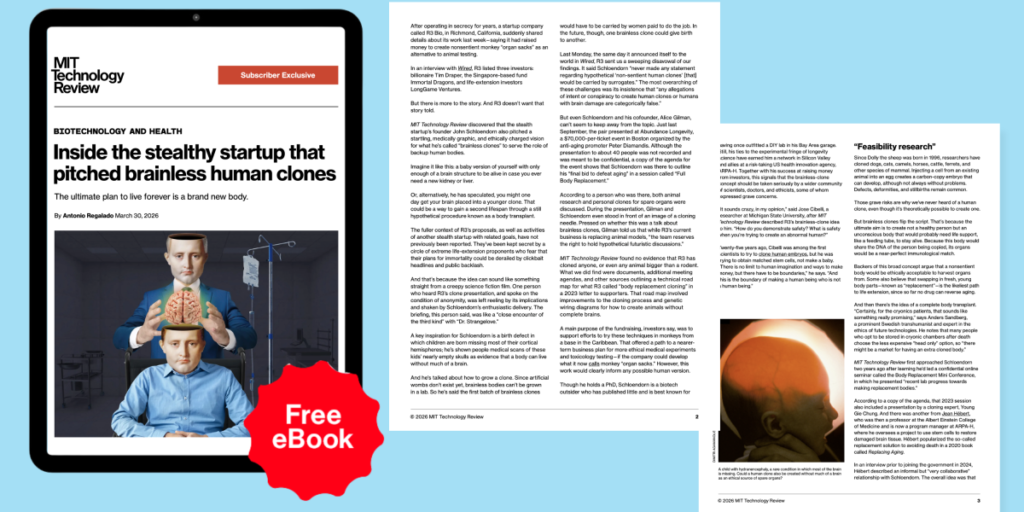

The ultimate life-extension play isn’t a pill, a diet, or some gene therapy. It’s a brand new body. And if R3 Bio has its way, that body will be a brainless clone of you—grown in a lab, waiting on a shelf until you need it.
Antonio Regalado at MIT Technology Review just published an exclusive eBook on this startup, and it’s exactly as strange and unsettling as it sounds. R3 Bio is a small, stealthy outfit that has been pitching what they call “brainless clones”—human embryos genetically modified to never develop a central nervous system. No brain, no consciousness, no pain. Just a blank vessel of your own flesh, ready for transplant when your original body gives out.
The ethical hairball here is enormous. On one hand, if you could grow a genetically identical body without a brain, you sidestep the whole “is it a person?” debate. It’s not a person if there’s no mind. But on the other hand, we’re talking about engineering human life specifically to be disposable. That’s a line we’ve danced around with animal cloning and organ farming, but this is different. This is you.
I’ve been following Regalado’s work on this for a while—he also wrote about the researcher who wants to replace your brain bit by bit, which is a related but distinct approach. That one’s more of a gradual swap, like the Ship of Theseus problem for your gray matter. R3 Bio’s plan is more brute force: grow a spare, then figure out how to move your consciousness into it. They haven’t solved that part yet, obviously. Nobody has.
What strikes me is how small this operation is. We’re not talking about a well-funded biotech giant with a PR team. This is a stealthy startup, likely operating under the radar of most regulators, pitching a vision that sounds like science fiction but is technically plausible. The eBook is behind MIT’s paywall, but if you have access, it’s worth your time. Regalado is one of the few journalists who can write about this stuff without either hyping it or dismissing it as crazy.
Related stories in the same issue include a piece on stem-cell therapies that actually work—part of their 10 Breakthrough Technologies list for 2025. That’s the grounded counterpoint to R3 Bio’s moonshot. Real progress in regenerative medicine is happening, but it’s incremental. Growing whole human bodies for parts is a different league entirely.
I’m not sure this will ever be legal, or safe, or even desirable. But the fact that someone is seriously trying to build it tells you where the longevity obsession is heading. The rich will always want to live forever, and they’ll pay for experiments that make the rest of us uncomfortable. R3 Bio is just the latest, and maybe the most extreme, example.
Read the full eBook at MIT Technology Review if you can. It’s a fascinating look at how close we are to making spare humans—and how far we still have to go.
Comments (0)
Login Log in to comment.
Be the first to comment!